
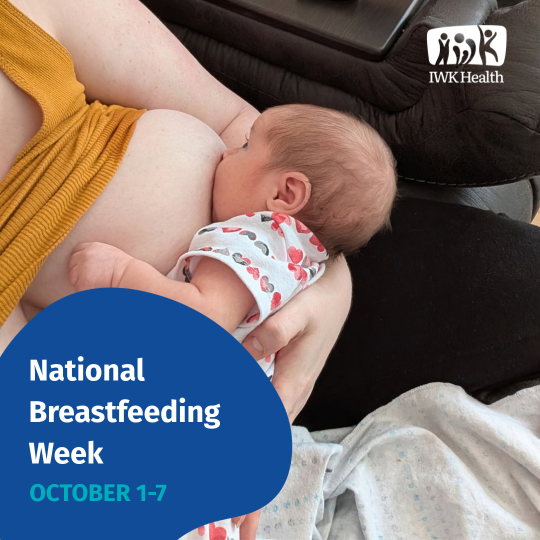
National Breastfeeding Week (NBW) is celebrated in Canada October 1 to 7 each year.
The theme this year is "Growing a Sustainable Start Together: Strengthen What Works."
Jasmin Underwood was generous to share about their experience with direct breastfeeding, pumping, supplementing, mental health, infant growth concerns, grief around feeding expectations, and ultimately being a mother recognizing that protecting her own wellbeing was part of caring for her baby.
Finding her own definition of feeding success
Before her baby was born, Jasmin Underwood was already worried that breastfeeding might not work for her.
Having polycystic ovary syndrome (PCOS)and gestational diabetes, she had seen four friends with similar experiences struggle to breastfeed. “Seeing four out of four friends with similar experiences unable to breastfeed made it feel like a 100 per cent failure rate. It scared me and weighed on me every second leading up to giving birth,” she says.
She responded by researching everything she could and even booked a lactation consultant to visit her home before her baby arrived. She wanted to feel prepared and empowered.
As part of her prenatal care, Jasmin was referred by her Public Health Nurse to Jennifer Jollymore, an IWK Birth Unit Clinical Nurse Specialist (CNS) and International Board Certified Lactation Consultant, for birth planning. During their work together, Jennifer recognized Jasmin’s significant anxiety around expressing colostrum and used a low-stimulation, individualized approach to help her learn the skill and build confidence.
One of the things Jasmin worked on before birth was expressing colostrum. She remembers being overwhelmed with anxiety but also remembers the individualized support that helped her feel capable.
“Spa music — check. Lights lowered — check. Affirmations in a jar that I was able to pick that you applied to the situation that I then put in my bra, hoping the affirmation would really apply to my breasts — check.”
When she finally collected a tiny amount of colostrum, she was so excited that she sent a photo to her lactation consultant. The only sanitary surface available was a mirror.
“It felt like it was a 1980's photoshoot of colostrum I was sending your way,” she laughs.
After her son was born, however, feeding became much harder than she had imagined. His latch was excellent, but Jasmin had inverted nipples, making direct breastfeeding challenging. At home, she created a daily checklist of strategies to try.
“Every day those ten attempts felt like ten failures,” she says.
Eventually, the pressure began to affect her mental health and her ability to simply enjoy being with her baby. Slowly, she stopped trying to feed at the breast and began pumping and bottle-feeding breastmilk instead.
“That was when I stopped crying when people asked me how feeding was going. I was able to say that he's drinking breastmilk from a bottle.”
Pumping brought its own challenges. Jasmin describes creating a “private pumping oasis” whenever possible, while also learning that caring for herself had to be part of caring for her baby.
“If your body is saying that it can't keep up, or that your brain can't do it anymore — THAT'S OKAY!”
Jasmin also experienced Dysphoric Milk Ejection Reflex, or D-MER, which caused intense feelings of rage and anxiety when she pumped. She wishes more families knew it was a real experience and that support was available.
Today, her baby is happy and healthy. His bottles are a combination of breastmilk and formula, after Jasmin accepted that she could not safely maintain enough breastmilk to meet his needs.
Her definition of success has changed, too.
“Success to me is finally being able to be more present with my baby, not pushing myself past the breaking point where he got what was barely left of me.”
For Jasmin, feeding success was not about reaching a particular milestone or feeding exclusively at the breast. It was about finding a way forward that allowed both her baby and herself to be cared for.
She hopes other parents struggling with feeding can hear that message, too.
“The last thing a patient wants to hear is that they're not trying hard enough,” she says. “They're fighting not just their body and their mind, but the unspoken societal pressures about how breastfeeding is natural, and that it must come naturally because millennia of women have been doing it. I would tell them that they are safe, their baby is safe, and that this is SO hard.”