
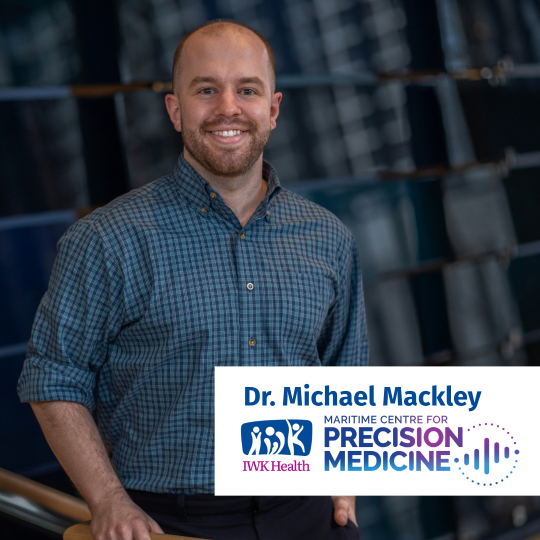
“To me, Precision Medicine is the opposite of a one-size-fits-all approach to health,” says Dr. Michael Mackley, Clinical Implementation Lead for the new IWK Maritime Centre for Precision Medicine. “Instead, it’s the idea that we can tailor or individualize someone’s care by integrating their unique biological information with knowledge about their environment, behaviours, social context, and lifestyle.”
For Mackley, this approach is both the future of healthcare and something he has trained for as a medical geneticist.
Mackley is a clinician-researcher with the IWK’s Maritime Medical Genetics Service and an Assistant Professor in the Department of Pediatrics at Dalhousie University. In his new role, he will help advance the integration of precision medicine into clinical care at the IWK and across the Maritime provinces.
A Nova Scotian who attended medical school at Dalhousie University, Mackley completed his training in Medical Genetics at the University of Toronto and SickKids and earned his doctorate from the University of Oxford as a Rhodes scholar. After several years in Ontario, his return to Nova Scotia represents a homecoming—and an opportunity to help build something new.
“Beyond that, though, the IWK represents a community of like-minded individuals with a shared goal of improving the health of children and women in the Maritimes,” he says.
Precision medicine is not entirely new to the IWK. Geneticists, genetic counsellors and other health professionals have been using genetic information to help diagnose and care for patients and families for decades. What is changing is the opportunity to expand that approach beyond specialized genetics services and make it part of care across the health system.
That is where the new IWK Maritime Centre for Precision Medicine comes in.
Mackley’s role as Clinical Implementation Lead is focused on helping clinicians incorporate precision medicine and genetics-informed care into their practices, and thus helping more patients and families benefit from advances in the field.
For patients, that could mean reaching a diagnosis sooner, particularly for families who have spent years searching for answers. A genetic diagnosis can also help guide treatment, identify potential complications, inform surveillance and prevention, and sometimes point to targeted therapies that may not otherwise have been considered.
The potential extends beyond diagnosis and treatment. Advances in areas such as pharmacogenomics could help clinicians select medications and doses based on an individual’s genetics, while other emerging tools may help researchers and clinicians better understand a person’s risk for common diseases.
For Mackley, the promise of precision medicine ultimately comes down to better understanding the individual behind the diagnosis.
“Integrating precision medicine into your practice can mean reducing long diagnostic odysseys and avoiding trial-and-error approaches to treatment selection,” he says. “By reducing diagnostic uncertainty, clinicians can be more confident in their decision-making.”
Making that vision a reality will require collaboration across the health system. Mackley sees the new Centre as an opportunity to bring clinicians, researchers and other partners together to help ensure patients and families in the Maritimes can benefit from the rapidly evolving field.
“The new IWK Maritime Centre for Precision Medicine provides an exciting opportunity to implement system-wide change and integrate precision medicine principles across the IWK and the Maritime provinces."