
The name of the youth in the following article has been changed to protect their privacy.
For Jon, an 18-year-old who recently received care at IWK Health’s Garron Centre, his experience with cannabis began in a way that may feel familiar to many young people—a casual habit that became part of a daily routine.
“I used it as a painkiller—for pain from playing football and different injuries—and it just became such a part of my life that it seemed like it was a positive thing. I didn't see any of the negative effects of it.”
But as he shifted toward high-potency products, the effects changed. What once felt positive eventually led to anxiety, sleep trouble, and a need for psychiatric care.
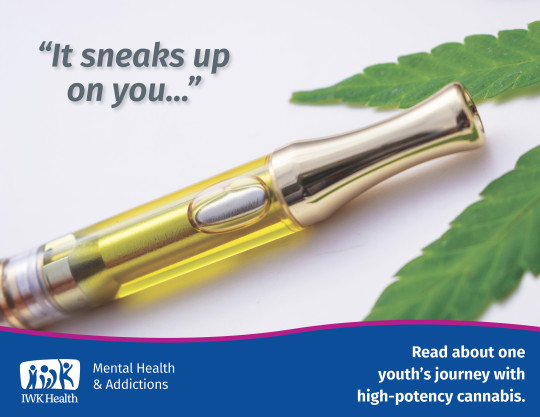
“By the time you realize you have a problem with it, it's kind of too late. You’re using it as a coping mechanism for whatever it may be, or use it to sleep, and [then] it becomes something you become dependent on. It sneaks up on you.”
Physicians at IWK Health’s Mental Health & Addictions program say that Jon’s experience reflects a troubling trend: more young people are experiencing significant mental health impacts linked to high-potency cannabis, including psychosis – a clinical condition characterized by a loss of contact with reality, often involving symptoms such as hallucinations, delusions, and disorganized thinking.
Dr. Kyle Godden, who provided care for Jon during his time at IWK Health, shares, “It’s very concerning that we’re seeing more youth coming into hospital with conditions like psychosis that appear to be related to high-potency cannabis use. In fact, it's become increasingly common for patients to tell us they are using potent cannabis products on a daily basis. Based on what we're seeing, these products are readily available, and it is very easy for young people to get their hands on them."
Jon says he shifted from using cannabis flower and edibles to primarily using vape pens—or “dab” pens—because they were convenient and discreet.
“As a parent, your kid can be hitting a dab pen every single night and you could have no idea. If he blows it out his window […] and he uses eye drops, you're going to have no idea that your kid is smoking cannabis every single night.”
Jon says it was the use of vape pens containing extremely high levels of THC—up to 90 per cent—that led to his family seeking support from IWK Health. He began experiencing escalating symptoms including persistent anxiety and disrupted sleep, and says that even when not actively using cannabis, he felt a lingering sense of not feeling fully “sober.”
“I had a lot more anxiety […] when I was in public situations, I felt a lot more anxious and like people were looking at me, and people were caring about what I was doing.”
Eventually, symptoms intensified into hallucinations, paranoia, and distrust of those who were trying to help him.
“I was hallucinating about certain things that weren't happening—like noises and sounds and stuff like that that just weren’t there.”
As his trouble sleeping and side effects got more severe, his family sought help through Nova Scotia’s 811 health service. This led to an in-home assessment and, eventually, an admission to IWK Health for psychiatric care.
Jon’s experience reflects a broader concern at IWK Health, where high-potency THC use among youth is linked to severe presentations of psychosis and other prolonged effects such as anxiety, depression, abdominal pain and vomiting, and aggression that can disrupt functioning at home, school, and work.
Nova Scotia has the highest rate of daily or near-daily cannabis use among youth aged 16–19 in Canada, along with a growing shift toward high-potency THC products such as vapes, concentrates, and edibles.
Dr. Sabina Abidi, Associate Chief of Psychiatry and Head of the Youth Psychosis Clinic at IWK Health, says “the availability and use of high potency cannabis—in vapes, dab pens, extracts, or shatter—among youth in Nova Scotia is a significant health concern. We are seeing higher rates of addiction and earlier onset of severe psychiatric illnesses like schizophrenia, especially in youth at risk. Developing brains are more vulnerable to the negative impacts of cannabis, especially in high concentration. For some, this can lead to significant disruption in brain function.”
A recent article in The Lancet Psychiatry reports rising rates of first-episode psychosis, potentially linked to substance use in younger age groups.
Dr. Phil Tibbo, the Dr. Paul Janssen Chair in Psychotic Disorders with the Department of Psychiatry at Dalhousie University, contributed to The Lancet Psychiatry article and shares that “Research, globally, reports that the cannabis products that youth are exposed to today are not the same product of 10-15 years ago. The potency of cannabis products has risen significantly in dried flower as well as vapes. The regular use of these high potency products has been linked with negative mental health outcomes, including psychosis.”
Jon says he’s grateful for the support he received from IWK Health and the team at the Garron Centre, and he hopes sharing his experience will help others understand the risks associated with high-potency cannabis products and the habitual use of cannabis.
Dr. Abidi says that education about the risks of exposing developing brains to the harms of high potency THC products is key to helping our youth make informed decisions.
She says, “ensuring lower-potency—legal—alternatives are available to our youth over 19, strengthening retail and online safeguards, and improving education for youth, parents, and caregivers are key factors that can help mitigate risk. Moreover, supporting our youth to consider other options, to ask questions, and to seek help early is crucial.”
…
The following resources can help guide you in understanding and discussing cannabis use with your family:
- Cannabis & Psychosis – Exploring the Link
- Talk with your family – Substance
- Sensible Cannabis Education Resources – Get Sensible
- Lower-Risk Cannabis Use Guidelines (LRCUG) for Youth | CAMH
If you or someone you care for is struggling with their mental health or with substance use, please reach out for help:
- Contact our Central Referral Line at 1-855-922-1122. A physician referral is NOT required.
- You can also book a phone appointment online
- In the event of an emergency, go to your nearest Emergency Department or call 911.
- Those experiencing a mental health crisis can contact the Provincial Mental Health and Addictions Crisis Line at 1-888-429-8167, available 24/7.
- You can also contact Kids Help Phone at 1-800-668-6868 or by texting CONNECT to 686868.