
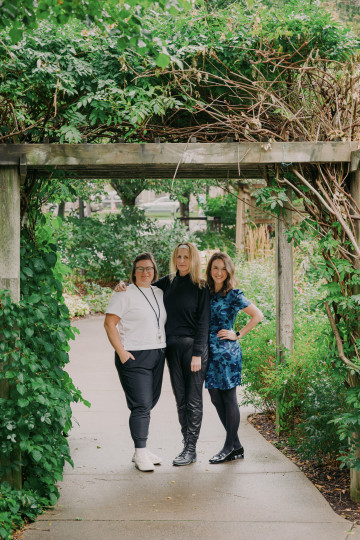
Left to right: Jennifer Bowdridge, Mary Stuart and Dr. Chelsea Ash. Photo by Ryan Wilson IWK.
For children with cancer, their families and their treatment teams, the objective is often on getting to the end of treatment. For Dr. Chelsea Ash and the team at IWK Health’s Long-term Follow-up Clinic (LTFU) the focus is on the rest of the survivor’s life.
“There’s a lot of focus and attention up until the patient rings the bell and that’s important,” said the Pediatric Hematologist-Oncologist. “But a lot of these kids do experience a lot of long-term complications and it’s really important to recognize that, too.”
The IWK’s LTFU clinic for childhood survivors of cancer is the first of its kind in Atlantic Canada. It was formally established with its own clinic space and team two years ago. Prior to that, the patient population was taken care of and had their concerns addressed, but not in the way the LTFU is able to now.
Four decades ago, the five-year childhood cancer survivor rate was less than 60 per cent. Thanks to medical advances that number is now more than 85 per cent. That amazing progress has shifted some focus from not just curing the cancer but also ensuring quality in the years following treatment.
“It’s not just about survival, but survivorship,” said Dr. Ash.
People who undergo cancer treatments as children are at risk of a long list of other illnesses and conditions.
“Every system of the body has the potential to be impacted by treatment,” said Dr. Ash.
Mental health has emerged as an area where survivors continue to feel a combination of relief and ongoing uncertainty. Survivors can experience PTSD, anxiety, and developmental challenges from missed socializing and school while receiving treatment.
As well, the radiation treatment survivors go through, which can vary by individual and type of cancer, can increase the risk of cardiovascular issues, diabetes and infertility, among other conditions.
Patients are seen annually at the LTFU in an extensive one-hour appointment that covers any concerns and compares test results in an effort to ensure any issues are caught early.
Dr. Ash completed a pediatric cancer survivorship fellowship in New York City before formalizing the clinic with Mary Stuart, a nurse practitioner who spent most of her career at Toronto’s Hospital for Sick Children and Princess Margaret Hospital working in hematology oncology in Pediatric and AYA survivorship. Jennifer Bowdridge is the hematology-oncology nurse coordinator in the clinic.
The clinic currently follows about 400 patients ranging in age from seven to 34 from across the Maritimes. Patients treated for leukemia are referred to LTFU two years post-treatment, while those treated for solid tumours and brain tumours and bone marrow transplant patients are all referred after five years.
“This is an area of interest globally,” said Dr. Ash. “It’s very cool that Nova Scotia and IWK gets to be a part of that conversation.”