
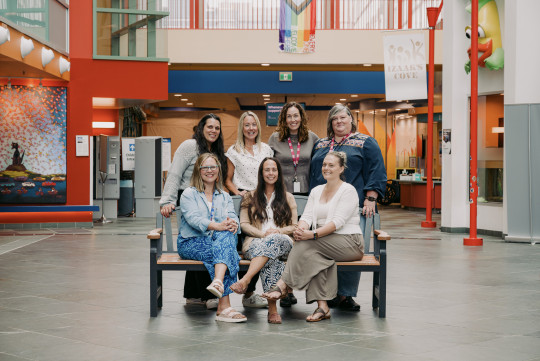
Photo Bottom row left to right - Gail MacRae Sly, Kim Kempton, Jenn Jollymore Top row - Steph Williams, Lori Campbell, Shauna Wilcox, Keltie McLean Missing - Meg Finley, Shelley Lowther, Aarika MacKay, Amy LeBouthillier, Jill Murphy, Laura Carnegy, Sarah King. Photo By Ryan Wilson IWK
Clinical Nurse Specialist (CNS) Recognition Week, held annually from September 1 to 7, is an opportunity to recognize the expertise and impact of CNSs and the important role they play in improving care for patients, families and health-care teams.
So, what exactly is a Clinical Nurse Specialist?
A CNS is an advanced practice nurse who combines clinical expertise with leadership, education, research and evidence-informed practice to improve care, support health-care providers and strengthen health-care systems.
At IWK Health, CNSs work across a variety of programs and specialties, meaning their roles can look quite different depending on the clinical area. What connects their work is a focus on clinical practice, leadership, education and research.
For Steph Williams, CNS with Emergency Mental Health and Addictions Services (EMHAS), an important part of the role is being able to work both at and beyond the bedside.
“We remain connected to patients, families and frontline teams while also having the opportunity to step back and ask: What are we seeing in practice? What’s working? Where are the gaps? And how can we make things better?”
In her role, about 30 per cent of Steph’s time is dedicated to direct clinical practice, working alongside staff and with youth and families in the Emergency Department. The remainder includes clinical consultation, education and mentorship, practice and policy development, quality improvement, research and supporting initiatives to improve mental health and addictions care.
One example of that work is TIDeS – Trauma-Informed Debrief and Support, a facilitated reflective support initiative that grew from a need identified within EMHAS.
Health-care providers regularly support patients and families through some of the most difficult moments of their lives. While that work can be incredibly meaningful, it can also take an emotional toll – not necessarily because of one major event, but because of the cumulative impact of many difficult moments over time.
TIDeS asks a simple question: What would it look like to apply the same trauma-informed principles used in patient and family care to support the people providing that care?
Rather than creating another meeting or incident review, TIDeS provides a structured, psychologically safe space where staff can pause, reflect and connect. Participants use “headline-level sharing,” allowing them to talk about the general shape of an experience without retelling potentially distressing details.
The approach focuses on reflection rather than problem-solving and support rather than fixing, guided by two questions: What is the work asking of us? What helps us carry it together?
Early feedback has highlighted staff feeling heard and supported, less alone and more connected to their colleagues. It has also helped staff recognize that the emotional demands and uncertainties of health care are often shared across professional roles.
For Steph, TIDeS is a clear example of what makes the CNS role so valuable.
“TIDeS began with something we were noticing within our own clinical environment,” she says. “When we brought the work to our broader CNS group, other CNSs recognized similar needs within their own areas.”
That ability to notice, connect and act is at the heart of the CNS role.
“Supporting staff wellbeing isn’t separate from quality care,” Steph says. “It is part of quality care.”
This year’s CNS Week theme, “Amplify: Making the Invisible Indispensable,” speaks to much of this work. Whether translating evidence into practice, mentoring colleagues, identifying gaps, developing education or connecting ideas across clinical areas, CNSs often work behind the scenes to create meaningful change.
“TIDeS is one example, but it represents what I value about the CNS role more broadly,” says Steph. “Staying connected to clinical practice, listening to what staff, patients and families are experiencing, connecting people and knowledge, and helping turn those experiences into meaningful change.”