
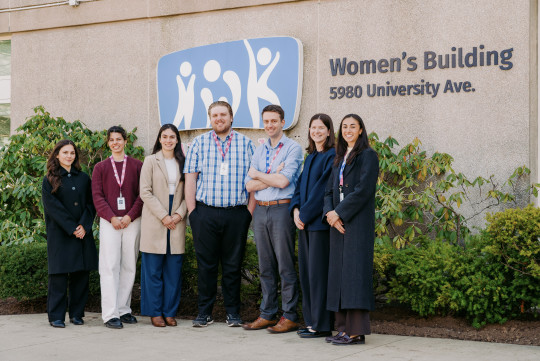
Left to right you have Hadley Bent, Kelsea McAllister, Onika Drabble, Mark Hamlin, Michael Drake, Elsie Gillis, Eve Daniels. Photo by Ryan Wilson IWK.
New Mitacs funding will support research and innovation at IWK, while an established engineering student program continues to develop the next generation of healthcare improvement leaders.
What does engineering have to do with healthcare? At the IWK, the answer is found in the everyday processes that help patients and families receive care, and in the people working to make those processes better.
Through a new partnership with Dalhousie University Engineering, supported by Mitacs Accelerate program, the IWK is creating new opportunities to apply industrial engineering expertise to healthcare challenges. The partnership will support internships that bring together students, academic researchers and IWK teams to explore new ideas, improve processes and help advance the quality and safety of care.
It also builds on something the IWK already knows well: engineering students can make a meaningful contribution to healthcare today, while developing the skills and experience to become tomorrow’s healthcare innovators.
“As a leading teaching institution, IWK Health is well-known and regarded for the critical role it plays in clinical learning,” says Michael Drake, Manager Process and System Improvement at the IWK, and co-lead of the student program with Kelsea McAllister. “This new, exciting partnership with Dalhousie Industrial Engineering will create an avenue where continuous improvement innovations developed in academia will be applied to current practices at the IWK and our exemplary teaching principles will help enrich the academic journey for industrial engineering students.”
Funding a new approach to healthcare innovation
Mitacs Accelerate brings together post-secondary students, postdoctoral fellows, academic researchers and partner organizations to solve complex challenges and advance new ideas through applied research and knowledge transfer.
The research award provides $1.26 million over five years to support interns as they work collaboratively with an academic supervisor and partner organization on a research project.
For the IWK, this creates an opportunity to work with Dalhousie University Engineering to explore how engineering methods, research and fresh perspectives can help improve hospital processes.
“We want our research to address real-world challenges alongside committed partners,” says Dalhousie University Professor Dr. Peter VanBerkel, who is the Principal Investigator on the Mitacs project “This partnership brings those two things together, giving us the opportunity to make meaningful progress on some of the complex healthcare delivery challenges faced by organizations around the world.”
Industrial engineering, in particular, offers tools to examine how work gets done, understand the movement of patients and information, identify opportunities for improvement and test new approaches.
The potential impact reaches beyond a single project. By connecting academic expertise with the realities of a busy children’s and women’s hospital, the partnership can help turn research and new ideas into practical improvements for patients, families and healthcare teams.
And for students, it offers the chance to gain hands-on experience in a setting where the purpose of their work is never far away.

Putting engineering to work for patients and families
The new partnership with Mitacs builds on theIWK’s previous experience working with students.
Elsie Gillis, an Industrial Engineering Student with Process and System Improvement, has spent all three of her co-op terms at the IWK.
During those placements, she has worked with teams across the women’s and children’s programs, gaining experience in process improvement, data analysis and understanding how care is delivered.
“Through my three semesters, I have worked with consultants on the Process and System Improvement Team to partner with areas of the hospital and do a deep dive into their processes,” Elsie says.
Often, she explains, hospital processes are shaped over time by in-the-moment decisions, changes and adaptations as healthcare evolves.
“It is often said that no one person designed a process to be a certain way.”
That is where the work of Process and System Improvement comes in: looking at those processes from a high level, identifying opportunities for change and finding ways to support a better patient experience, improved safety and a better working environment.
“While we are often working with numbers, and processes, people are truly at the forefront of what we do,” Elsie says.
Helping the Neurology Clinic see the bigger picture
During her most recent co-op term, Elsie led a project with the Neurology Clinic.
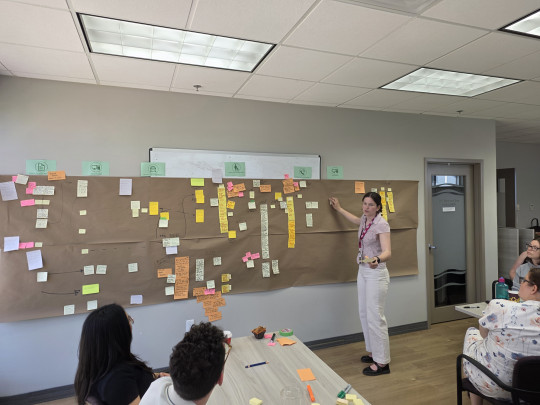
She began by meeting with clinical and administrative staff to understand how the clinic worked and establish goals for the project. She then facilitated a half-day workshop where staff collaboratively mapped the flow of patients and information through the clinic.
The workshop helped identify opportunities for growth and improvement, leading to work now underway around waitlist management and ensuring the right patient is seen at the right time.
For Elsie, the project was an opportunity to put engineering skills into practice while working alongside the people who understand the clinic best.
It also demonstrated the value of bringing different perspectives together to understand a process and identify opportunities to improve it.
From a classroom activity to a Quality Summit experience
Elsie’s work at the IWK has extended beyond process improvement projects.
During her second co-op term, she worked with another member of the Process and System Improvement team to design and facilitate a presentation for Take Your Kid to Work Day, introducing students to what engineers can do in a healthcare setting.
One of the activities used simulation, a tool industrial engineers often use to test new processes and understand potential outputs and risks.
The team created a game where students became the simulation. Mocking up a real emergency department they identified bottlenecks in queues and then tested suggested changes.
In her final semester, Elsie and the team were asked to adapt the activity for the IWK Quality Summit, where staff members took part in the simulation game.
Both events offered participants an opportunity to get out of their seats and understand how processes can be improved in a fun and engaging way.
A place to learn—and contribute
For Elsie, the experience of working at the IWK has been about more than developing technical skills.
“What I have found unique about my placement at the IWK is the ability to be surrounded by and reminded of the impact you can have with improvement projects,” she says.
While she may be examining patient flow or analyzing data at a high level, working in a hospital keeps her connected to the reason behind the work: patients and families.
“Being someone who grew up in Halifax, Nova Scotia, I have been on the receiving end of amazing care the IWK provides, and it excites me that I am able to, if even in only a small way, contribute back to the quality of care the IWK provides.”
As she heads back for her final year of her Bachelor of Engineering at Dalhousie University, Elsie hopes to continue doing process and system improvement work at the IWK after graduation.
Building a pipeline of engineering talent
Elsie’s experience is part of a broader story.
The IWK’s engineering student program has helped create a pathway for students to gain experience in healthcare—and for the IWK to develop relationships with talented engineers who can go on to contribute as full-time team members.
Two examples are Onika Drabble and Mark Hamlin, who both began their IWK careers as students before joining the organization full time.
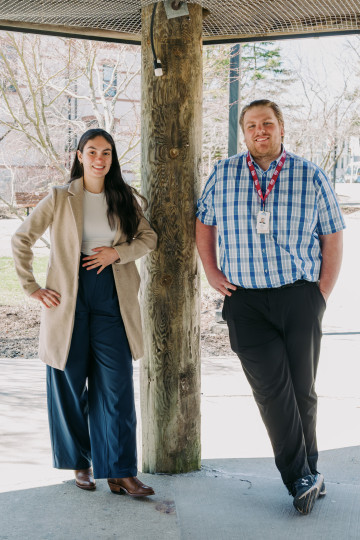
Onika: From clinical genomics to continued innovation
Onika’s original student work at the IWK was with Clinical Genomics.
The project went on to win an award at Dalhousie University (2024 Eldon Gunn Award for Best Solution Provided to a Client), and its work has continued to develop since Onika graduated and joined the IWK full time.
The project was also featured at this year’s IWK Quality Summit, providing an opportunity to share the work and its ongoing impact with colleagues across the organization. It was awarded Best Oral Presentation.
Mark: A student project with lasting impact
Mark also began working with the IWK in a student capacity, completing multiple projects during his time with the organization.
One of those projects focused on the outpatient blood clinic. Using a data-driven approach with heuristic methods and simulation modeling, the team were able to recommend solutions that promised a 58 per cent reduction in patient wait and 72 per cent reduction in overtime.
The project was also notable as Onika served as mentor to Mark, sharing what she had learned two years previously as a student.
Like Onika’s work, Mark’s project won an award at Dalhousie University (2026 Eldon Gunn Award for Best Solution Provided to a Client). The work has continued onward since his graduation and transition to a full-time role at the IWK.
It was also featured at this year’s IWK Quality Summit.
Together, these projects demonstrate how student work can extend beyond a co-op term. Ideas developed by students can continue to evolve, contribute to improvements at the IWK and become part of the organization’s ongoing work in quality and innovation.
Investing in people and the future of healthcare
The new Mitacs Accelerate partnership with Dalhousie University Engineering creates another opportunity to bring research and industrial engineering expertise into the IWK.
It also builds on the value of an established student program—one that gives students the opportunity to learn from experienced teams, contribute to meaningful projects and see the impact of their work in a healthcare setting.
For Elsie, Onika and Mark, the connection between engineering and healthcare is about more than processes, numbers or technical solutions.
It is about people.
It is about finding ways to make care better for patients and families, creating safer and more effective working environments, and developing the talent that will help the IWK continue to innovate.
As the IWK and Dalhousie Engineering begin this new chapter together, the opportunity is clear: bring research, fresh ideas and engineering expertise into healthcare—and help turn those ideas into lasting improvements.
“Our students want to use their engineering skills to make the world a better place,” says Dr. VanBerkel. “Working with IWK gives them the opportunity to develop those skills while contributing to improvements that directly affect patients, families, and healthcare providers.”