
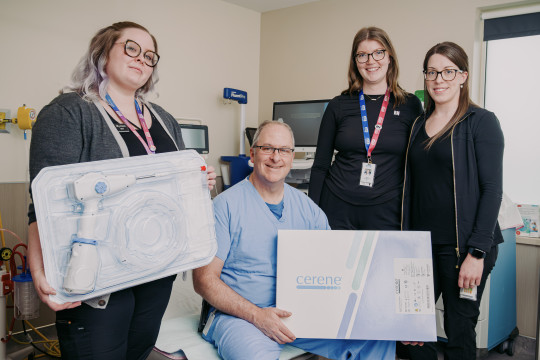
From left to right: Myriam Lapointe, Dr. David Rittenberg, Brae Greencorn, Megan LeLoup. Photo by Ryan Wilson IWK.
IWK Health has become the first site in Canada to perform Cerene cryoablation therapy, an innovative treatment option for patients experiencing heavy menstrual bleeding. The introduction of this technology marks a significant milestone in women’s health care and positions the organization at the forefront of advancing minimally invasive gynecological care.
The first Cerene procedures in the country were successfully completed at IWK in March 2026, following the device’s recent approval by Health Canada.
Dr. David Rittenberg, Ambulatory Lead of Gynecology at IWK Health, describes Cerene as a new approach to endometrial ablation that uses freezing rather than heat.
“Cerene is an endometrial ablation technique that uses liquid nitrogen to destroy the endometrial lining of the uterus,” says Rittenberg. “This results in a reduction or cessation of menstrual bleeding in patients with heavy flow.”
The adoption of Cerene treatment in Canada follows the publication of the CLARITY study in 2022, a pivotal trial conducted across 11 investigative sites, including two in Canada. Despite the study’s promising results, the Cerene cryotherapy device had not been used domestically until now, pending regulatory approval. IWK’s early implementation underscores its leadership in bringing cutting-edge treatments to Canadian patients.
Traditionally, endometrial ablation procedures in Canada rely on heat or electrical energy to remove the uterine lining. These procedures are often performed in operating rooms or specialized procedure suites and typically require moderate sedation. As surgical wait times continue to grow, access to these treatments has become increasingly limited.
Heat based techniques are very effective and have high rates of patient satisfaction but can also scar the endometrial cavity, which may complicate future diagnostic procedures such as biopsies. This has led to hesitation among some clinicians, particularly when treating patients at higher risk for endometrial cancer, even though overall cancer risk after ablation is considered reduced. As a result, rates of endometrial ablation have declined despite strong evidence supporting its effectiveness.
Cerene treatment offers a different approach. The procedure takes approximately three minutes and can be performed in an office setting with minor pain management. Its cryoablation method destroys the endometrial lining while generally preserving the structure of the uterine cavity, allowing for future access if further investigation is needed.
While the rate of complete cessation of menstruation (amenorrhea) may be lower compared to heat-based methods, patient satisfaction remains high. Most patients report lighter or more normal bleeding, and studies indicate a reduction in menstrual cramping following treatment.
The shift to an ambulatory setting is expected to significantly reduce wait times and improve access to care. Patients benefit from quicker procedures, faster recovery, and a return to normal daily activities, often as soon as the next day.
For clinicians and staff at IWK, the introduction of Cerene treatment expands the range of available treatment options and supports the organization’s commitment to innovation.
“This allows us to offer the most up-to-date technologies in women’s health,” says Rittenberg, “and aligns with our goal of being a leader in delivering high-quality, patient-centered care.”