
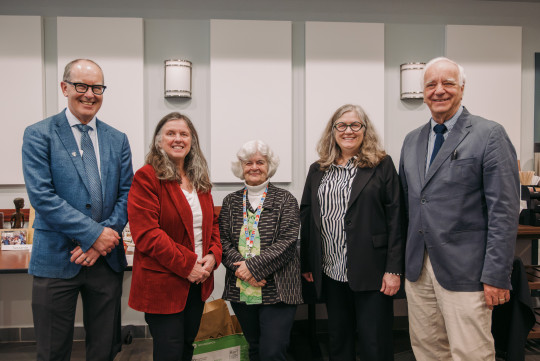
Left to right: Dr. David Anderson, Dean, Faculty of Medicine, Dalhousie University; Dr. Krista Jangaard, President and CEO, IWK Health; Dr. Noni MacDonald, Co-founder, MicroResearch and Professor Emerita, Dalhousie University and IWK Health; Dr. Jennifer Bain, Associate Vice-President Research, Dalhousie University; Dr. Bob Bortolussi, Co-founder, MicroResearch and Professor Emeritus, Dalhousie University and IWK Health. Photo by Ryan Wilson IWK.
MicroResearch celebrated an important milestone on May 11 as the organization officially became a Dalhousie Research Institute while continuing its longstanding role as an IWK Research Centre.
The event recognized the partnership between the IWK Health and Dalhousie University - highlighting the impact MicroResearch has had in communities locally and internationally since its founding in 2008.
Co-founded by Dr. Noni MacDonald and Dr. Bob Bortolussi, in collaboration with colleagues in Uganda, MicroResearch supports community-driven research by giving local teams the tools and training to identify and solve issues affecting their own communities.
“The MicroResearch Institute will bring people together from three faculties - Medicine, Health, and Agriculture,” explained Dr. Bortolussi. “With their help, MicroResearch will now be able to address the wider needs of people around the world.”
MicroResearch has trained more than 1,800 participants across 11 countries and supported projects focused on health, mental wellness, community supports, and other local priorities. In Canada, projects have explored issues ranging from adolescent access to mental health services in Nova Scotia to community health and wellbeing. For example, commercial fish harvesters in Newfoundland and Labrador identified a need for targeted trauma supports since the industry experiences high rates of fatalities which dramatically impact small communities.
Dr. Bortolussi emphasized that the organization’s work is rooted in the belief that communities are best positioned to identify solutions that fit their own realities.
“We’ve found that local problems need local solutions by local people,” he said. “I’m proud that MicroResearch gives local people the tools (research) to answer questions that allow their brothers and sisters to improve their lives and the lives of those in the community.”
Dr. MacDonald highlighted that approach is especially valuable at a time when communities and healthcare systems are facing increasing pressures.
“We are in a time of much instability and changing pressures,” she noted. “We indeed need to do more with less, and that is one of the important outcomes of MicroResearch. It’s about finding solutions to community problems that fit the culture, the context and the resources.”
As MicroResearch begins this new chapter as a Dalhousie Research Institute, its focus remains on empowering communities to drive meaningful change through locally led research.