
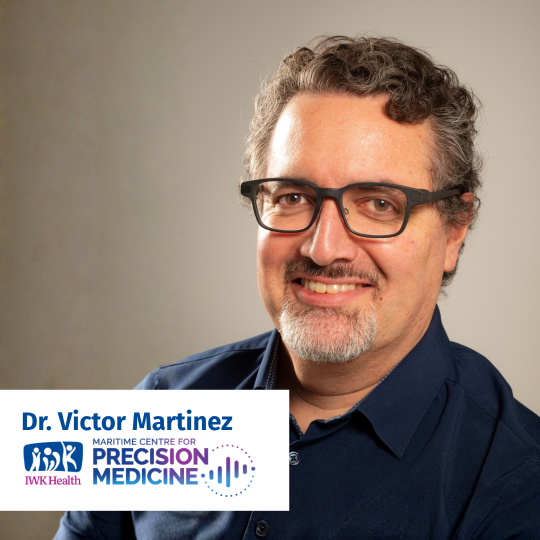
For Dr. Victor Martinez, precision medicine starts with a simple idea: the more we learn from the information available to us, the better equipped we are to care for the next patient.
“Every test and every clinical detail we record can help us care for the next patient, but only if we organize and share that information responsibly,” says Martinez, who leads Data Analytics for Precision Medicine at the IWK Maritime Centre for Precision Medicine. He is also a Clinical Bioinformatician in the Clinical Genomics Laboratory and an Associate Professor in Pathology at Dalhousie University.
While precision medicine is often associated with genetic testing and targeted treatments, much of the work that makes these advances possible happens behind the scenes. It involves organizing and interpreting vast amounts of biological and clinical information, developing new analytical tools and ensuring that knowledge gained from one patient can help others.
That intersection of data, research and patient care is what makes precision medicine so compelling for Martinez.
Trained in molecular biology and cancer genomics, Martinez completed his PhD at the University of Chile while working with the BC Cancer Research Centre in Vancouver. He subsequently completed a postdoctoral fellowship there, where he began working in bioinformatics — the use of computational tools to analyze and interpret biological data.
Through this work, he saw the potential of genomic information to transform our understanding of disease.
“I saw how much genomic data could tell us about disease, and I was pretty convinced genomics would become a big part of medicine,” he says.
Precision medicine offered a way to bring that research closer to patients. Martinez wanted to build on his research background by gaining more clinical experience, and he is now training in Genetic and Genomic Diagnostics through the Canadian College of Medical Geneticists to become a clinical scientist who uses data to help guide patient care.
His work at the IWK has already helped establish important foundations for that future.
Following the arrival of Genome Canada funding, Martinez and his colleagues helped establish exome analysis and cloud-based bioinformatics capabilities, enabling the team to analyze patients’ genomic information and identify genetic changes that may explain their conditions. It is an example of how research investment can translate into new diagnostic opportunities for families in the Maritimes.
Over nearly eight years at the IWK, Martinez has worked as both a principal investigator and a research collaborator, helping secure just over $20 million in research funding for genomics and precision medicine.
But the value of genomic data extends beyond any single test or patient. Interpreting a genetic result often requires comparing an individual's DNA with information from many other people. When evidence is limited, a result may remain uncertain. As researchers and clinical laboratories build and responsibly share larger datasets, they can strengthen the evidence used to interpret genetic changes sometimes helping resolve cases that have remained unexplained for years.
“Sometimes, the best answer for one patient comes from what we have learned from others,” Martinez says.
It is a principle he champions through his work on the Canadian College of Medical Geneticists' Data Sharing Committee. He helped contribute to the committee's position statement on genetic data sharing by clinical laboratories in Canada, published in The American Journal of Human Genetics in 2026. The statement supports making responsible data sharing a standard practice, with appropriate safeguards based on risk.
Martinez and his colleagues are also exploring how artificial intelligence (AI) can help make genomic analysis more efficient and precise.
One project, SmartRequisition, funded by Genome Canada, uses AI to extract relevant clinical features from a patient's medical history when a genetic test is ordered. By bringing these details together, the tool can help laboratory specialists prioritize genetic variants that are more likely to explain the patient's symptoms and condition.
The goal is not to replace clinical expertise, but to give specialists better information with which to make decisions.
That same philosophy informed a pilot project at the IWK that explored using large language models to help draft disease descriptions and review scientific literature. The work used de-identified information, underwent the IWK's privacy and legal review, and included review of every output by a laboratory scientist. Drafting a disease description that previously took about two hours was reduced to approximately 24 minutes, saving the team around 284 hours of documentation work.
For Martinez, the time saved represents an opportunity to redirect specialist expertise toward interpreting results and answering important questions for patients and families.
He emphasizes, however, that AI is only as useful as the data and tools behind it. New technologies must be tested carefully against real clinical questions, with experts evaluating where they work well and where their limitations lie.
That is why he sees the IWK Genomics Data Repository, developed with the Clinical Genomics Data Team, as such an important achievement. The repository provides a foundation for research, data analysis and future advances in precision medicine.
“I am very proud of the team that made it a reality,” he says. “When a team takes an idea and goes beyond your hopes, it shows the foundation was solid.”
Martinez describes the development of precision medicine at the IWK as a collective effort, built by people who share a belief in the potential of genomics, research and innovation to improve care.
The creation of the IWK Maritime Centre for Precision Medicine provides an opportunity to bring these efforts together and extend their benefits across the region. For Martinez, that means making research and AI part of the Centre's everyday work, while ensuring that new approaches are carefully evaluated and translated into clinical practice.
“If we test new ideas carefully and share what we learn, families here can benefit from new advances as soon as they are available,” he says.
His vision is for the IWK to continue advancing precision medicine across the Maritimes and become a leader in the field in Canada, ensuring that discoveries made through research can lead to better information, more timely diagnoses and more personalized care for the patients and families who need it.