
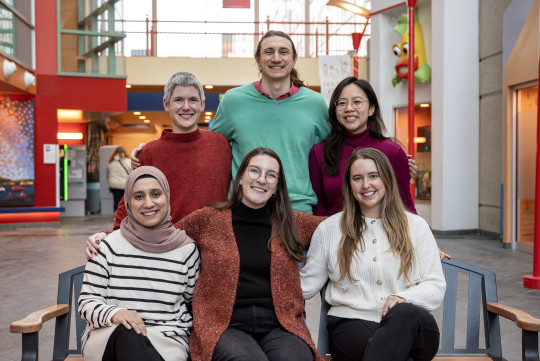
Front row, left to right- Teba Hamodat, Siann Gault, Taylor Wasylyshyn
Back row, left to right- Alex Rubin, Jason Crutcher, Hazel Ngo
photo by Ryan Wilson, IWK
“I know I’m in the right field because the work truly doesn’t feel like ‘work,’” says Taylor Wasylyshyn, a psychology resident at IWK Health. “I feel motivated by all of the amazing children and families I get to meet, learn from, and support.”
Every September, six psychology residents begin their training at the IWK, working across the Children’s Health Program, Mental Health and Addictions Program, and Provincial Preschool Autism Services. Grounded in a scientist-practitioner model, the program provides intensive training for PhD and PsyD students in pediatric health and child and adolescent clinical psychology.
Over the course of the year, residents gain extensive supervised experience in assessment, diagnosis, consultation, program development and evaluation, and evidence-based intervention—while becoming part of a deeply collaborative care community.
Wasylyshyn just completed a rotation in Pediatric Health Psychology and will be continuing on in a Neuropsychology rotation as a main area of interest. For her, the work feels less like a job and more like a calling.
“Being able to provide clarity, validation, and practical direction, and seeing the relief and hope that can come with that, is what makes this work so fulfilling for me.”
Siann Gault is currently completing her rotation in the Preschool Pediatric Psychology Service. There, she conducts assessments for children up to age six with neurodevelopmental and medical conditions affecting cognitive and behavioural development.
What has stood out most to Gault is the culture of care within the hospital.
“People here care deeply about the work they do and the families they work with,” she shares, recalling moments when staff noticed a lost family and stepped in to help. “This type of observant, caring, above-and-beyond behaviour really stood out to me… and makes a positive impact on the families we work with.”
Alex Rubin is completing rotations in Community Mental Health and Addictions and the Eating Disorders Specific Care Clinic, with upcoming training in the OCD Specific Care Clinic and Provincial Preschool Autism Services. Across these settings, Rubin provides evidence-based assessment and intervention to children, adolescents, caregivers, and families.
“I am especially passionate about supporting neurodivergent and transgender/gender diverse young people through my clinical work, research, and advocacy,” Rubin explains. Having moved from the United States for the residency, Rubin describes feeling welcomed and supported from the very beginning. “I feel fortunate to be receiving excellent training from highly skilled clinicians, and I look forward to continuing to grow as a clinical psychologist in such a supportive environment.”
Teba Hamodat is completing rotations at the Garron Centre and Community Mental Health and Addictions, with upcoming work in autism assessments and pediatric health psychology. Hamodat’s motivation centres on empowering young people and their families.
“Children and youth are so resilient, and I love the opportunity to empower them by equipping them with new skills to help navigate life’s challenges and potentially influencing their trajectories moving forward!”
Hazel Ngo, a psychology resident in the Health Track, is currently completing an intervention rotation in Rehabilitation Psychology, working alongside interdisciplinary teams to support children and youth with physical disabilities, acquired brain or spinal cord injuries, and other complex needs.
“My experience at the IWK has deepened my passion for the area of health psychology, which focuses on the intersection of psychological and physical health,” Ngo shares. “I find the most meaningful part of this work is helping clients and families feel seen during their most vulnerable moments and find personal meaning during difficult times.”
Ngo is inspired by the collaboration she witnesses daily.
“It is incredible to see how different healthcare professionals bring their own expertise to work together, while sharing the same underlying commitment to the families they serve.”
Jason Crutcher recently completed six-month rotations in neuropsychology and pediatric health psychology and is beginning new rotations with the rehabilitation team and the Brief Intensive Outreach Service (BIOS). He is motivated by helping children and families find and access individualized mental health, communication, and academic supports that best meet their unique needs.
“I’m most passionate about understanding brain–behaviour relationships across different neurological conditions and among neurodiverse individuals’” says Crutcher. “I’m particularly interested in different language and communication styles, and in helping neurodiverse individuals communicate their needs effectively across a variety of settings.”
Together, these residents embody the mission of the Pre-Doctoral Residency Program at IWK Health: combining scientific rigor with compassionate care to support children, youth, and families—and to prepare the next generation of clinical child psychologists for meaningful, collaborative practice.