
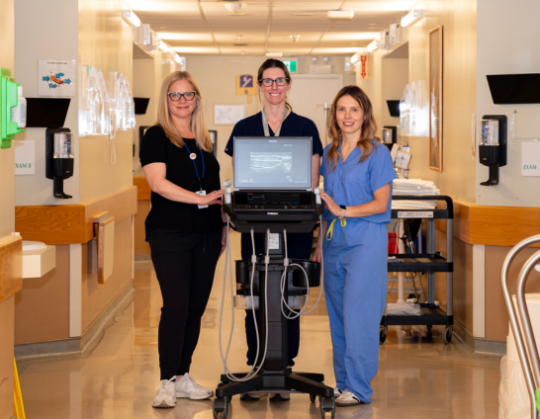
Photo by Ryan Wilson IWK
Jessica Branch spent nearly two decades searching for answers to pain that many dismissed in minutes.
As a teenager, her periods were never “normal.” They were heavy and often so painful they caused vomiting. At first, she assumed—as many are told—that this was simply part of being a woman. But over time, the pain changed. It spread beyond her cycle, becoming a daily presence that ranged from a dull ache to debilitating episodes that left her curled up in bed, unable to function.
The impact reached far beyond the physical: chronic pain began to shape her mental health, bringing anxiety and depression. It affected her ability to spend time with her children, and slowly, it began to define her daily existence.
“I felt like I could not plan things in advance because I wouldn’t know how I would feel the day of,” she explains. “Chronic pain took over my life.”
It’s a struggle Krista Hollett also knows all too well.
“I suffered from chronic pelvic pain, severe headaches and debilitating fatigue which affected my mental health and negatively impacted my quality of life,” Hollett recalls.
A long and frustrating medical journey
Branch’s path to care was anything but straightforward.
After waiting years to see a gynecologist, she finally secured an appointment. The outcome was devastatingly familiar to many living with endometriosis: she was told to “just take pain medication,” that it was “just a bad period,” and that she should “learn to live with it.”
“I wasn’t willing to accept that,” Branch says.
Determined to find answers, she began researching on her own and ultimately sought out a private gynecologist located two hours away. That decision marked a turning point: for the first time, she felt heard.
“Finally, someone took me seriously and listened to me.”
She was referred to the IWK Endometriosis & Chronic Pelvic Pain (E&CPP) Clinic, a specialized program designed to treat complex pelvic pain conditions.
Hollett says her path to the clinic was driven by a search for more options.
“I asked to be referred to see if there were other treatment options available to me,” she explains. “I suffered in pain for years before officially being diagnosed in 2018 after a diagnostic laparoscopy.”
A different kind of care
Branch’s experience at the clinic was unlike anything she had encountered before.
“At my first visit, I met with the entire team,” she recalls.
That team-based, multidisciplinary approach became a cornerstone of her care. Instead of relying on a single provider, Branch received ongoing support from multiple specialists working together.
“The nurse practitioner helped me with the medications I was on while awaiting a surgery date. The physiotherapist gave me exercises and advice to try to help my pain,” she explains. “The social worker gave me a safe place to express all of my feelings with someone who understood what I was going through.”
Hollett also accessed several services through the clinic, including pelvic floor physiotherapy, nerve blocks and counselling with a social worker.
“It helped to have access to the different treatments offered that I otherwise would not have had access to,” she says.
“After years of being overlooked by doctors, having near constant contact with the team made me feel like I wasn’t forgotten about and I would still be taken care of,” adds Branch.
Surgery and a turning point
In October 2025, Branch underwent a hysterectomy along with excision surgery performed by one of the E&CPP Clinic’s gynecologists.
The results were life-changing.
“If I could go back, I would have done the surgery so much sooner,” she says. “Even the pain of recovery was less than what I was living with most days. I am finally now able to plan things to do with my family without worrying about being curled up in pain.”
While Hollett continues to live with symptoms, she says her time with the E&CPP Clinic has made them more manageable.
“I am still suffering but able to manage the severity of my symptoms with the treatments I have received,” she explains.
Why specialized care matters
Both women’s stories highlight a broader issue: the long and often difficult road many face before receiving appropriate care for endometriosis and chronic pelvic pain.
“I spent years on waitlists for doctors who didn’t understand this kind of pain,” Branch says. “It wasn’t until I saw doctors specialized in this type of pain that I was finally understood.”
Hollett emphasizes how critical timely access to care can be.
“It’s very important to increase access to care and lower the time it takes to receive a diagnosis and prevent treatment delays,” she says.
She adds that while the E&CPP Clinic has been invaluable, she hopes to see even more services and capacity to help more patients.
“It would be helpful to have other specialists involved like a gastroenterologist, urologist, and dietitian,” Hollett says.
Branch strongly believes in the need for more clinics like the IWK program—spaces where expertise, validation and comprehensive care come together.
“We need more of this,” Branch says. “People shouldn’t have to wait decades for help.”
A message for Endometriosis Awareness Month
After years of being dismissed, for both Branch and Hollett, awareness starts with something simple but powerful: sharing and listening.
“Period pain isn’t normal. Please talk to your doctor if you are suffering,” Hollett says.
“Endometriosis is so often overlooked because you can’t see pain by looking at someone. It’s so much more than ‘just a heavy period’,” Branch adds. “Please start taking women seriously when they express their symptoms. We don’t just want pain medication, we want to be heard, understood and given real help.”
March is Endometriosis Awareness Month